
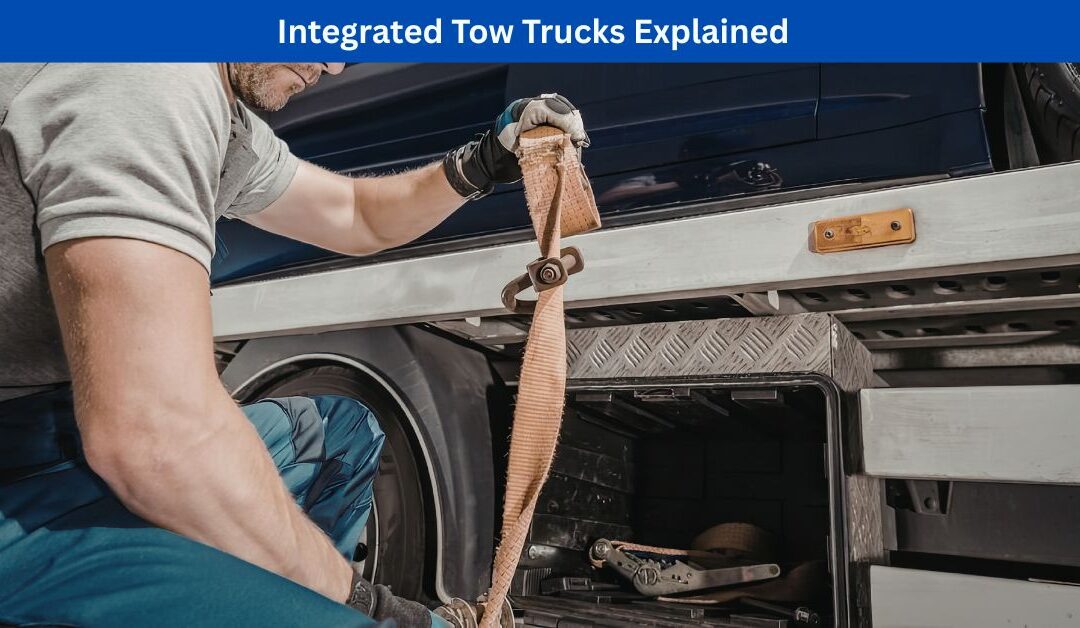
Integrated tow trucks are some of the most powerful and advanced vehicles used in the towing industry today. They are specially designed for heavy-duty and complex recovery operations where standard tow trucks are not strong enough. These trucks combine multiple towing systems into one unit, making them highly efficient, stable, and versatile. Understanding how integrated tow trucks work helps you see why they are widely used for accident recovery, repossession, and heavy vehicle towing.
1. What Is an Integrated Tow Truck?
An integrated tow truck is a heavy-duty vehicle that combines a boom system and wheel-lift system into one compact unit. Unlike standard tow trucks, which may rely on separate mechanisms, integrated trucks have both lifting and towing capabilities built directly into the structure of the vehicle.
These trucks are designed with extra axles and reinforced frames to handle extreme weight and pressure. This makes them ideal for towing large vehicles such as buses, trucks, and heavily damaged cars.
One of the key features of integrated tow trucks is their stability. Because the lifting and towing systems are built into the truck itself, they offer better balance and control during recovery operations. This reduces the risk of accidents while handling heavy loads.
They are commonly seen in busy highways, accident scenes, and commercial transport operations where fast and reliable towing is required.
2. How Integrated Tow Trucks Work
Integrated tow trucks operate using a combination of hydraulic systems, wheel-lift arms, and boom mechanisms. When a vehicle needs to be towed, the operator positions the truck carefully and uses hydraulic controls to extend the lifting arms.
The wheel-lift system is then used to secure the front or rear wheels of the vehicle. At the same time, the boom system can provide additional lifting power or stabilization, especially for heavy or damaged vehicles.
Once the vehicle is secured, the integrated system lifts it off the ground and stabilizes it for transport. The design allows for precise control, which is essential when handling large or unstable vehicles.
Because everything is controlled hydraulically from inside the cab, the operator can make adjustments quickly and safely. This makes integrated tow trucks highly efficient in emergency situations.
3. Common Uses of Integrated Tow Trucks
Integrated tow trucks are primarily used in situations that require strength, precision, and speed. One of the most common uses is accident recovery, especially on highways where large vehicles may be blocking traffic.
They are also widely used for vehicle repossession. Their quick setup and strong lifting capacity make them ideal for safely removing vehicles without causing delays or disruptions.
Another important use is heavy-duty towing. Vehicles such as delivery trucks, buses, and construction equipment often require integrated tow trucks due to their size and weight.
In addition, these trucks are used in complex recovery situations where vehicles are stuck, overturned, or positioned in difficult angles. Their versatility allows operators to handle a wide range of roadside challenges efficiently.
4. Advantages of Integrated Tow Trucks
One of the biggest advantages of integrated tow trucks is their power. They are designed to handle extremely heavy loads that standard tow trucks cannot manage. This makes them essential for commercial and highway operations.
Another advantage is speed and efficiency. Since both lifting systems are built into one unit, operators can complete towing jobs faster without needing additional equipment.
Stability is also a major benefit. The integrated design provides better weight distribution, which reduces the risk of imbalance during towing. This is especially important when dealing with large or damaged vehicles.
Additionally, integrated tow trucks offer high precision control. Hydraulic systems allow operators to make small adjustments during the towing process, ensuring the vehicle is handled safely.
Overall, these advantages make integrated tow trucks one of the most reliable options in the towing industry.
5. Safety Features and Operator Control
Safety is a critical part of integrated tow truck design. These vehicles are equipped with advanced hydraulic braking systems, reinforced frames, and stability controls to ensure safe operation during heavy towing.
Operators also receive specialized training to handle these trucks. Because they are used in high-risk situations, such as accidents or heavy recoveries, precision and experience are essential.
Inside the cab, the operator has full control over the lifting arms, boom system, and towing adjustments. This allows for real-time decision-making based on road conditions and vehicle stability.
Warning lights, reflective markings, and safety barriers are also standard features, helping protect both the operator and other road users during towing operations.
These safety systems ensure that even in complex situations, towing can be completed with minimal risk.
Conclusion
Integrated tow trucks are a vital part of modern towing operations. Their combination of strength, stability, and advanced hydraulic systems makes them ideal for handling heavy-duty and complex recovery jobs.
From accident recovery to commercial vehicle towing, these trucks provide the power and precision needed to manage difficult roadside situations safely and efficiently. As vehicles and road systems continue to evolve, integrated tow trucks will remain an essential tool in keeping roads clear and safe.
Contact Us
Berwick Towing & Transport
27B William Rd
Berwick VIC 3806
(03) 7035 7815
www..berwick-towing.com.au/