
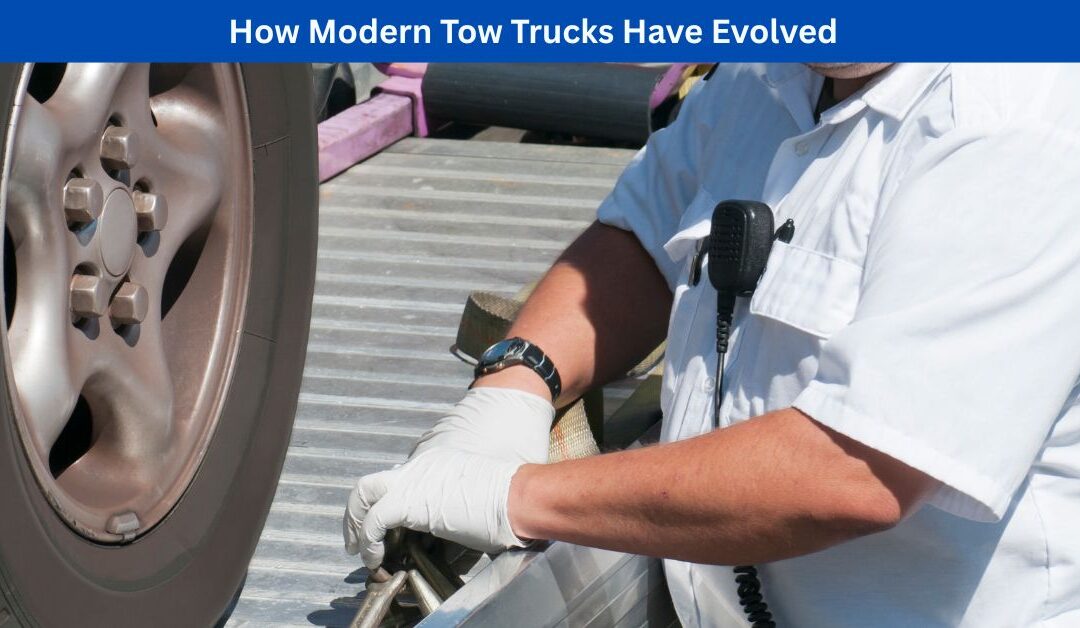
Tow trucks have come a long way from their early, basic designs to the highly advanced recovery vehicles we see today. What once started as simple machines used for dragging broken cars has now become a sophisticated industry built on safety, technology, and efficiency. The evolution of modern tow trucks reflects major improvements in vehicle engineering, road safety standards, and customer service expectations. Understanding how tow trucks have evolved helps you appreciate how professional towing has become faster, safer, and more reliable than ever before.
1. The Early Days of Towing
In the early stages of the towing industry, tow trucks were very basic. They were often modified pickup trucks or standard vehicles fitted with simple hooks, chains, and manual winches. These early systems were designed mainly to move disabled vehicles rather than protect them.
Hook and chain methods were commonly used, where chains were attached to the vehicle’s axle or frame and the car was dragged along the road. While this worked for the time, it often caused damage to tires, suspension, and bodywork.
Safety standards were also minimal compared to today. Drivers had limited control over lifting and securing vehicles, and towing was more about function than protection. As vehicle usage increased, the limitations of these early systems became more obvious, leading to the need for better technology.
2. Introduction of Hydraulic Systems
One of the biggest turning points in towing evolution was the introduction of hydraulic systems. Hydraulics allowed tow trucks to lift and move vehicles with much greater control and precision.
With hydraulic booms and lifting arms, operators could safely raise vehicles without relying on chains alone. This reduced damage and made towing more stable and predictable.
Flatbed tow trucks also became more practical due to hydraulic tilt systems. These allowed the bed to lower and tilt so vehicles could be easily driven or winched onto the platform.
Hydraulic technology transformed towing from a rough mechanical process into a controlled and professional service. It significantly improved safety for both vehicles and operators.
3. Development of Flatbed and Wheel-Lift Technology
As vehicles became more advanced, towing methods also needed to evolve. This led to the development of flatbed and wheel-lift tow trucks, which are now widely used in the industry.
Flatbed tow trucks introduced a major improvement by allowing the entire vehicle to be transported off the ground. This eliminated road contact, reducing wear and preventing further damage during transport.
Wheel-lift systems were also developed as a faster alternative for short-distance towing. These systems use a metal yoke to lift two wheels off the ground, making it easier to quickly remove vehicles from busy roads.
Together, these two technologies replaced older hook and chain methods for most modern applications. They offered better safety, faster response times, and more flexibility for different towing situations.
4. Integration of Modern Technology
Modern tow trucks are no longer just mechanical machines—they are now highly technological systems. One of the biggest improvements has been the integration of GPS tracking and digital dispatch systems.
GPS allows towing companies to locate the nearest available truck instantly, reducing response times and improving efficiency. Drivers can be sent directly to the exact location of a breakdown without delays or confusion.
Digital dispatch systems also help manage workloads, assign jobs, and track progress in real time. This improves communication between drivers and dispatch centers.
In addition, modern tow trucks are equipped with advanced hydraulic controls, onboard computers, and safety monitoring systems. These upgrades allow operators to perform more precise and safer towing operations.
Technology has made towing more organized, faster, and more customer-friendly than ever before.
5. Safety Improvements and Modern Standards
Safety has become one of the most important focuses in the evolution of tow trucks. In the past, towing was more dangerous due to limited equipment and manual handling. Today, strict safety standards guide every towing operation.
Modern tow trucks are equipped with warning lights, reflective markings, stabilizing systems, and reinforced frames to ensure safe operation on busy roads. These features help prevent accidents during roadside recovery.
Operators also receive professional training to handle different types of vehicles and situations safely. They are trained in loading techniques, traffic safety, and emergency response procedures.
In addition, modern towing companies follow strict industry regulations to protect both drivers and vehicles. This includes proper vehicle securement, equipment maintenance, and safe working practices.
These improvements have made towing one of the safest roadside services available today.
Conclusion
The evolution of tow trucks shows how far the industry has come—from simple hook-and-chain systems to advanced hydraulic, GPS-enabled recovery vehicles. Modern tow trucks are faster, safer, and more efficient, thanks to decades of technological improvements and safety innovations.
Today’s towing services are built around protecting vehicles, reducing response times, and ensuring driver safety. This evolution has transformed towing into a professional and highly reliable service that plays a crucial role in road safety and vehicle recovery.
Contact Us
Berwick Towing & Transport
27B William Rd
Berwick VIC 3806
(03) 7035 7815
www..berwick-towing.com.au/