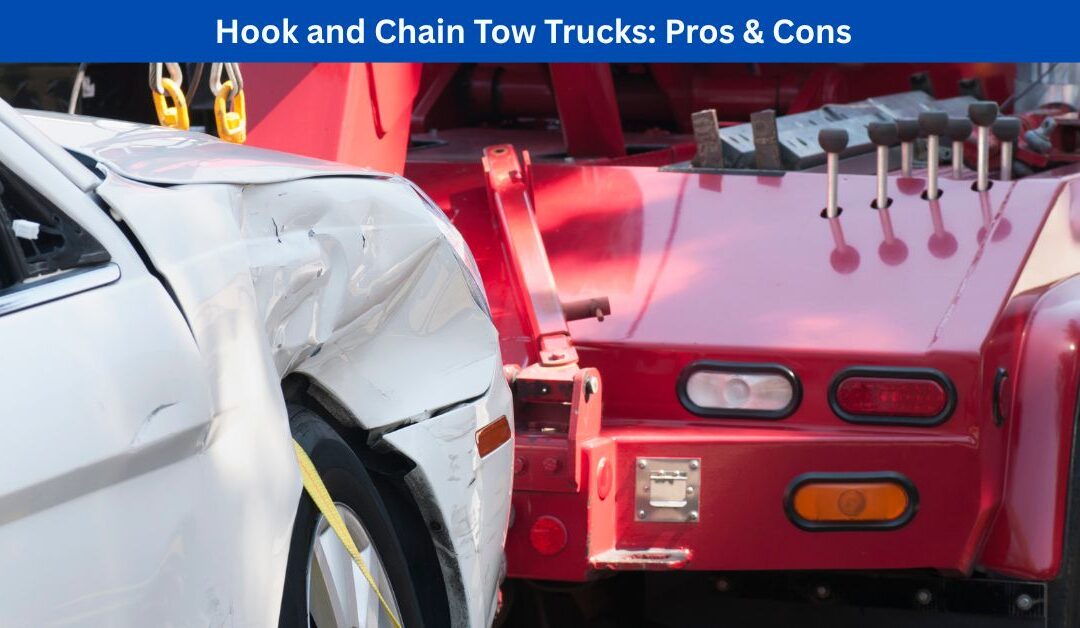
Hook and chain tow trucks are one of the oldest towing methods used in the vehicle recovery industry. While they are not commonly used today for modern cars, they still have a place in specific towing situations. This method involves using heavy chains attached to a vehicle’s frame or axle to lift and tow it. Although simple and strong, it comes with both advantages and disadvantages that make it suitable only for certain types of jobs.
Understanding how hook and chain towing works, where it is used, and its limitations helps you see why modern towing methods like flatbed and wheel-lift have largely replaced it.
1. How Hook and Chain Tow Trucks Work
Hook and chain towing operates using a basic but powerful mechanism. The tow truck uses a large hook attached to strong chains, which are secured around the vehicle’s axle or frame. Once attached, the front or rear of the vehicle is lifted off the ground, while the remaining wheels are dragged along the road.
This system was widely used in the early days of towing because it was simple, durable, and effective for moving broken or abandoned vehicles. The truck’s winch system helps lift the vehicle, and the chains hold it in place during transport.
However, because part of the vehicle remains in contact with the road, this method can cause wear and tear. It is also less stable compared to modern towing systems, which is why it is now used only in limited situations.
2. Advantages of Hook and Chain Tow Trucks
Despite being an older method, hook and chain towing still offers some benefits in specific scenarios.
One of the main advantages is its simplicity. The system does not require complex hydraulic equipment, making it easier to operate and maintain. This can be useful in rural or low-resource areas where advanced tow trucks may not be available.
Another advantage is strength. Hook and chain systems are capable of towing heavily damaged or non-functional vehicles that cannot be rolled or lifted using standard methods. This makes them useful for scrap yards and vehicle disposal services.
It is also a cost-effective solution. Since the equipment is basic, the operational cost is lower compared to modern towing systems. This makes it suitable for situations where the condition of the vehicle is not a concern.
3. Disadvantages and Risks of Hook and Chain Towing
While hook and chain towing has some benefits, it also comes with significant drawbacks. The biggest issue is potential damage to the vehicle. Because chains are wrapped around the frame or axle, they can cause scratches, dents, or structural stress during towing.
Another concern is that part of the vehicle is dragged on the road. This can lead to tire damage, suspension strain, and even underbody wear, especially if the road surface is rough or uneven.
This method is also unsuitable for modern vehicles. Today’s cars often have sensitive systems, low ground clearance, and advanced drivetrains that can be easily damaged by this type of towing.
Safety is another issue. Compared to flatbed or wheel-lift trucks, hook and chain systems offer less stability during transport, which increases the risk of shifting or imbalance.
4. Why Hook and Chain Tow Trucks Are Less Common Today
With advancements in towing technology, hook and chain tow trucks have become less common in modern roadside assistance. The industry has shifted toward safer and more vehicle-friendly methods like flatbed and wheel-lift towing.
Modern vehicles are built with complex engineering systems that require careful handling. Hook and chain towing simply does not provide the level of protection needed for today’s cars.
In addition, safety standards in the towing industry have improved significantly. Companies now prioritize methods that reduce damage risk and ensure smoother transport. Flatbed towing, in particular, has become the preferred option because it eliminates road contact entirely.
Because of these improvements, hook and chain towing is now mostly used only in specialized or non-standard situations.
5. Where Hook and Chain Tow Trucks Are Still Used
Even though it is outdated for most modern vehicles, hook and chain towing is still used in certain industries. One of the most common uses is in scrap yards and junk vehicle removal. Since the condition of the vehicle is not important, damage during towing is not a concern.
It is also sometimes used for heavily damaged vehicles that cannot be lifted using modern equipment. In such cases, the goal is simply to move the vehicle from one place to another, not to preserve its condition.
In some remote or low-resource areas, hook and chain systems may still be used due to their simplicity and affordability. However, even in these cases, they are gradually being replaced by safer alternatives.
Professional towing companies today only use this method when absolutely necessary and when no other option is suitable.
Conclusion
Hook and chain tow trucks played an important role in the history of the towing industry, but their use has significantly decreased due to modern safety standards and vehicle technology. While they are strong, simple, and cost-effective, they also come with risks such as vehicle damage and lack of stability.
Today, they are mainly used for scrap vehicles or special recovery situations where vehicle condition is not a priority. For most roadside assistance needs, safer and more advanced methods like flatbed and wheel-lift towing are preferred.
Understanding the pros and cons of hook and chain towing helps you see why modern towing has evolved and why professional companies choose safer methods to protect your vehicle.
Contact Us
Berwick Towing & Transport
27B William Rd
Berwick VIC 3806
(03) 7035 7815
www..berwick-towing.com.au/